A Password Can Be Reset. A Face Cannot. The Hidden Cost of the AI Photo Trend
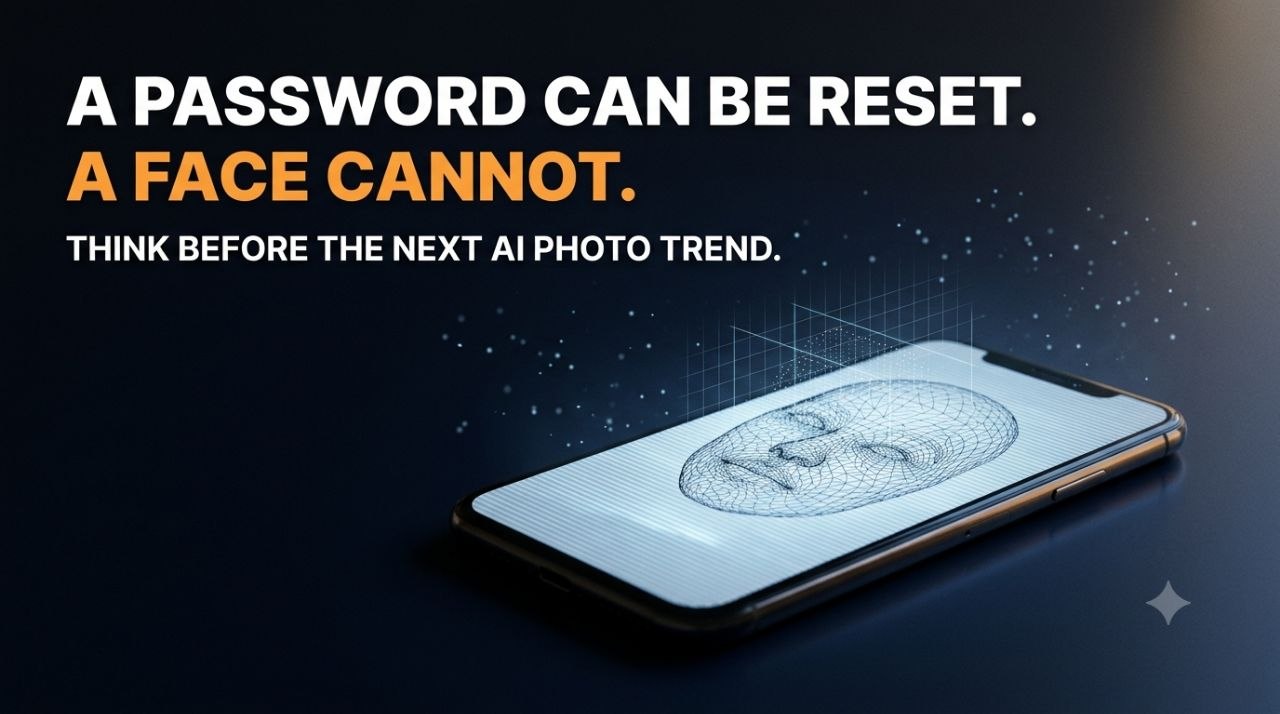
The trend is everywhere right now. You upload a selfie, and an AI app turns it into a retro 80s yearbook portrait, a vintage Bollywood poster, a cinematic saree photograph, or a childhood version of yourself. The results are fun, shareable, and genuinely clever. Millions of Indians have done it.
Every one of these trends asks for the same thing. A clear, well-lit, front-facing image of your face. Which happens to be exactly the kind of image that matters most, and the one you can least afford to lose control of.
Here is the single sentence that this whole article rests on. If your password leaks, you change it in a minute. If your face leaks, there is nothing to change. You cannot issue yourself a new face.
Why a Face Is Not Just a Photo
For most of history, a photograph of your face was harmless. What changed is that your face is now a key. In India, more than in almost any country on earth, your face unlocks real things.
Aadhaar now supports face authentication, and that face authentication has been extended to private-sector applications. DigiYatra lets you walk through more than 28 airports using your face as your boarding pass, with over 75 lakh users enrolled. Face-based payment systems are being piloted. Your face is quietly becoming a login credential for your identity, your travel, and your money.
The law recognises this. Under India's Digital Personal Data Protection Act, and under the Aadhaar Act before it, biometric information including your facial image is treated as sensitive personal data. As one legal summary put it plainly, ordinary data can be minimised, deleted, and forgotten when its purpose is served, but biometric data, once compromised, creates a permanent, irreversible harm.
A password is a secret you choose. A face is a fact you cannot revoke.
How This Can Be Exploited
The risk is not that every AI photo app is malicious. The risk is that you usually cannot tell what happens after you tap upload. Here are the real ways a fun photo trend can be turned against you.
Permanent harvesting. Your uploaded face can be stored, converted into a mathematical face template, and kept indefinitely. Unlike a leaked card number, a face template cannot be cancelled and reissued. Once it is in a database, it is there.
Repurposing beyond the fun edit. Data you give for one reason, a retro portrait, can quietly be reused for another, such as training facial recognition models, building advertising profiles, or being sold onward to data brokers. This often happens through long, vague privacy policies that almost nobody reads.
Hidden metadata. The photo you upload frequently carries invisible metadata, including the location, the device, and the exact time it was taken. The app can learn not just what your face looks like, but where you were and when.
Deepfake raw material. A clean, front-facing, high-resolution portrait is precisely the ingredient needed to build a convincing deepfake of you. Bidfoil has written before about how deepfakes of Indian public figures are made. The same technique works on a private citizen, and it starts with exactly the kind of clear face image these trends collect.
The clone-app trap. This is the biggest India-specific danger. When a trend goes viral, dozens of copycat apps appear that mimic the official interface. Many exist for the sole purpose of harvesting the faces and personal data of people who installed the wrong one. The official trend may be reasonably safe. The fake version pretending to be it is not.
What Not to Do
You do not have to give up the fun entirely. You have to be deliberate. Here is the practical list.
Do not install copycat apps. Use only the official platform running the trend, downloaded from the official app store listing. If an app you have never heard of is suddenly everywhere, treat it as a harvester until proven otherwise.
Do not upload faces that are not yours to give. Photos of children, of elderly relatives, of the deceased, or of friends who never consented, are not yours to hand to an AI company.
Do not skip the privacy policy entirely. Check three things. How long do they keep your upload. Do they use it to train their models. Can you delete it afterwards. If the answers are unclear, that vagueness is itself the warning.
Do not leave metadata in the photo. Take a screenshot of your photo and upload the screenshot instead of the original file. A screenshot strips most of the hidden location and device data.
Do not forget to clean up. Where the app allows it, delete your uploaded images and disable any activity or training permissions once you have your result.
The Honest Bottom Line
None of this means the AI photo trends are a trap to be feared. It means your face deserves more thought than a password does, because it protects more and cannot be replaced.
You already guard your Aadhaar number, your card details, and your OTP. In a country where your face now opens your airport gate, your bank, and your identity, your face belongs on that same list. The retro portrait is fun for a day. The face is yours for life. Spend the thirty seconds to protect it before you tap upload.