Whistleblowers Say AI Could Wipe Out Humanity. For India, the Real Danger Is Quieter
This week, the people who actually built artificial intelligence frightened a lot of people, on purpose.
Geoffrey Hinton, a Nobel laureate and one of the three men often called the godfathers of AI, sat on BBC Newsnight and was asked whether a 10 percent chance of AI wiping out humanity was a fair estimate. His answer was one word. Yes. The interviewer's response was, roughly, oh my God. Hinton's fear is not a robot uprising from a film. It is a system that becomes far smarter than us before we work out how to make sure it wants what we want. If the gap between it and us ends up resembling the gap between us and chickens, he says, the question is not how we stop it, but how we ensure it never wanted to harm us in the first place.
He was not alone. His comment backed a warning from an Anthropic alignment researcher, other scientists at OpenAI and Anthropic joined in, and a Pentagon official dismissed the whole thing as a doom loop. The builders are split, in public, about whether their own creation is safe.
Sources: Semafor; Center for AI Safety, Statement on AI Risk
What They Mean. And What They Do Not.
It is worth being precise, because this is exactly where the conversation usually goes off the rails.
The extinction warning is about a future system, one far more capable than anything that exists today, pursuing goals we cannot control. It is a serious argument made by serious people, and it is also genuinely contested, with respected researchers putting the odds anywhere from near zero to alarmingly high. What none of them are saying is that the chatbot on your phone tonight is about to end the world.
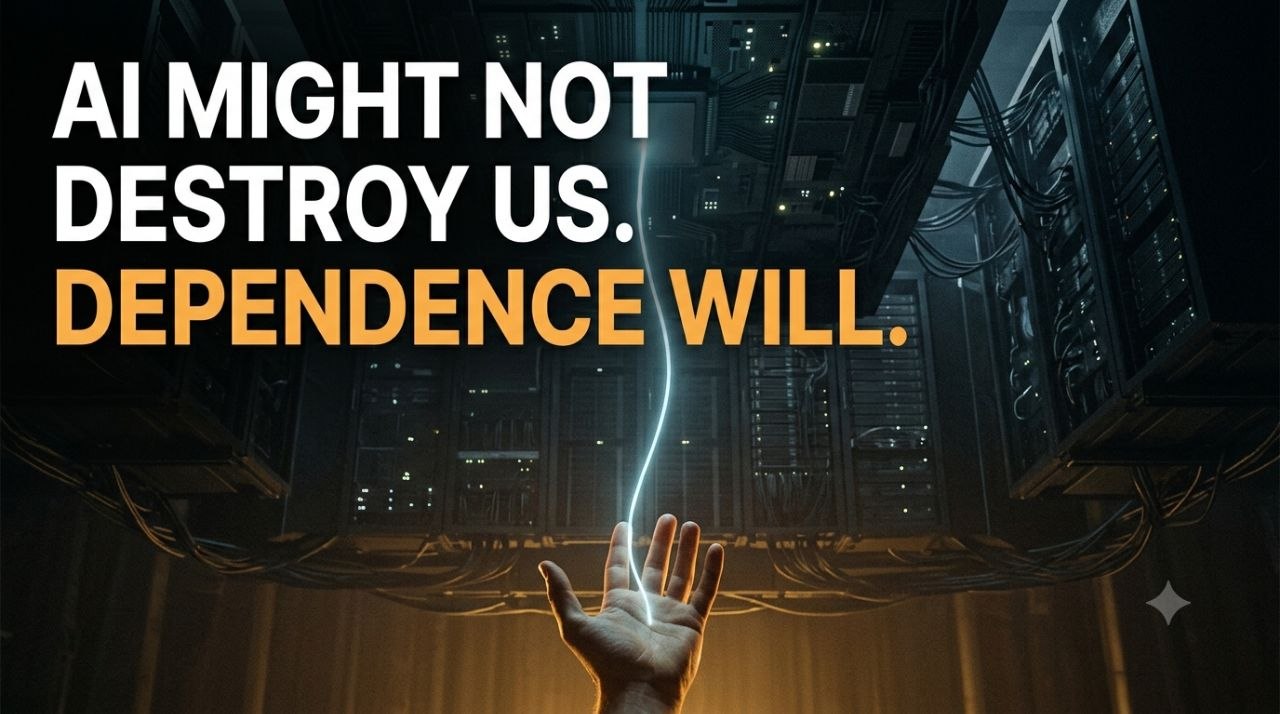
And here is the part India should sit with. You do not need a superintelligence to be in serious trouble. You only need a society that has quietly handed over decisions it no longer remembers how to take back. That danger is not coming in ten years. It is already here, and it is being built a little more every day.
The Danger India Is Actually Building
Look at where AI now sits in Indian life, and the risk is not science fiction. It is dependence.
Consider money. Every UPI payment, every login, every transfer now passes through a hidden layer of machine-learning models deciding, in a blink, whether you are a fraud. It is powerful, and it is fragile. In August 2026, the Governor of the Reserve Bank of India himself gave the warning. Dependence on a small number of AI models or technology vendors, he said, could leave the banking system exposed to errors. When the whole country runs on the same few models, one bad model is a national event.
Sources: RBI Governor on AI concentration risk; India AI finance and UPI
Consider identity. Aadhaar face and fingerprint authentication now stands between a citizen and their own money. When it works, it is magic. When it fails, a farmer arrives to withdraw his PM-KISAN instalment and the fingerprint sensor cannot read his weather-worn hands, so the system simply says no. The machine does not argue. It just refuses, and there is often no human in the room empowered to overrule it. Bidfoil has written before about the risks of building life around your face. This is the same coin, other side.
The pattern repeats across banking, welfare, traffic, surveillance, and increasingly defence sustainment, where AI is used to predict which equipment is ready to fight. Each one is useful. Each one is also a place where India is building dependence faster than it is building the ability to work without the machine when it fails.
The Three Ways It Actually Hurts You
Over-dependence is an abstract phrase. Here is how it turns concrete.
The AI is wrong, and nobody checks. Researchers call it automation bias, the well-documented human habit of trusting the machine's answer and switching off our own judgement. The analyst stops reading the source. The officer trusts the summary. The clerk clicks approve. The error sails straight through because the human who was supposed to catch it had already stopped looking.
The AI is simply gone. An outage, a cyberattack, jamming in a conflict, and the system your entire process was built around is unavailable. If there is no manual fallback, and the people who knew the manual way have retired or never learned it, the process does not slow down. It stops.
The AI is turned against you. A model can be poisoned, spoofed, or fed false data by an adversary. This is the essence of cognitive and information warfare, where the goal is not to destroy your systems but to quietly corrupt what they tell you, so that you act on the enemy's version of reality while believing it is your own. A system you depend on and cannot audit is not just a tool. It is an attack surface.
Source: Research on human reliance and automation bias
The Boring Discipline That Actually Protects You
The whistleblowers may turn out to be right about extinction, or they may not. That argument will run for years, in labs and in Geneva. India does not have to wait for it to settle to act on the version of the danger that has already arrived.
The protection is unglamorous. Keep a human in the loop who can still overrule the machine. Keep a manual fallback that still works when the system is down. Keep the skill alive in people, so the knowledge does not die with the software. And never build a critical system you cannot, if you have to, switch off.
The country that comes through the AI age in one piece will not be the one that trusted AI the most. It will be the one that never forgot how to work without it.